

Funding: National Highway Traffic Safety Administration (NHTSA) through the National Center for Manufacturing Sciences
Collaborators: University of Delaware Center for Composite Materials (UD-CCM), BMW, Barrday, and other industry partners
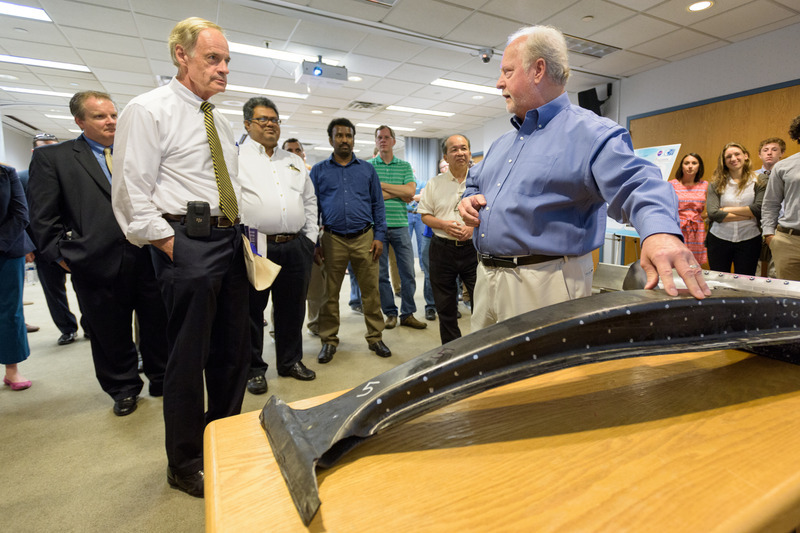
The B-Pillar project demonstrated the feasibility of carbon fiber-reinforced thermoplastic composites in safety-critical automotive structures. The team designed, manufactured, and crash-tested a full-scale B-pillar assembly, achieving ~60% mass reduction compared to steel while meeting FMVSS 214 side-impact performance requirements.
Performance evaluation employed a hierarchical testing and simulation workflow, from material coupon testing to component- and full-vehicle-level crash simulations using CATIA, HyperWorks, and LS-DYNA. Drop tower impact testing verified correlation between predicted and measured responses, confirming compliance with structural integrity and intrusion criteria.
Scalable manufacturing approaches were demonstrated using stamp forming, resin transfer molding, automated adhesive bonding, and robotic trimming. The project successfully advanced thermoplastic composite B-pillar technology to TRL 7, representing a validated production-ready solution.