

Funding: U.S. Department of Energy, Vehicle Technologies Office (DE-EE0009656)
Collaborators: UD-CCM, Clemson University, Honda, The Ohio State University, Westlake, ExxonMobil, Siemens, Moldex3D, and others
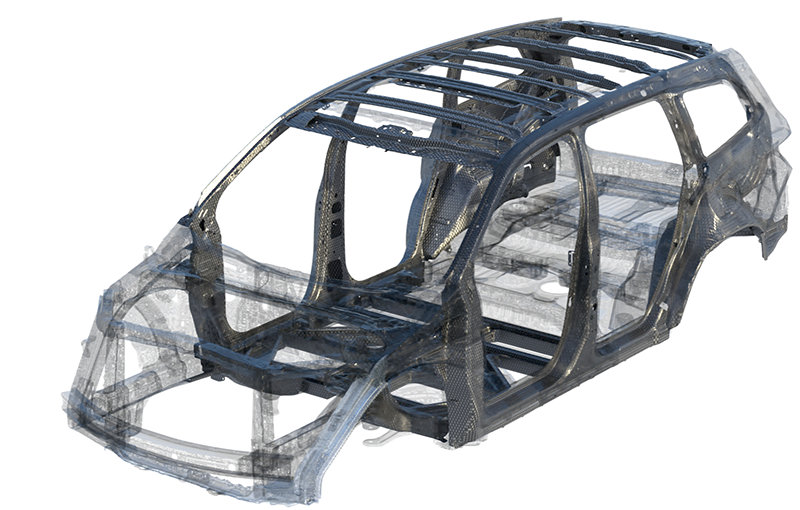
The Glider Project is focused on developing a composite-intensive, multi-material body-in-white (BiW) architecture that integrates fiber-reinforced polymers with metallic structures for lightweight, high-performance vehicle platforms.
A key innovation is the implementation of Ultrasonic Additive Manufacturing (UAM) to fabricate metal–composite transition joints that are spot-weldable and structurally robust, ensuring seamless integration of dissimilar materials within conventional weld-line assembly operations.
The project combines multi-scale modeling, digital process simulation, and experimental validation to optimize joining interfaces, mechanical performance, and manufacturing throughput. The resulting structure demonstrates significant mass reduction, lower lifecycle emissions, and enhanced crashworthiness, supporting DOE objectives in lightweighting and sustainable vehicle manufacturing.